

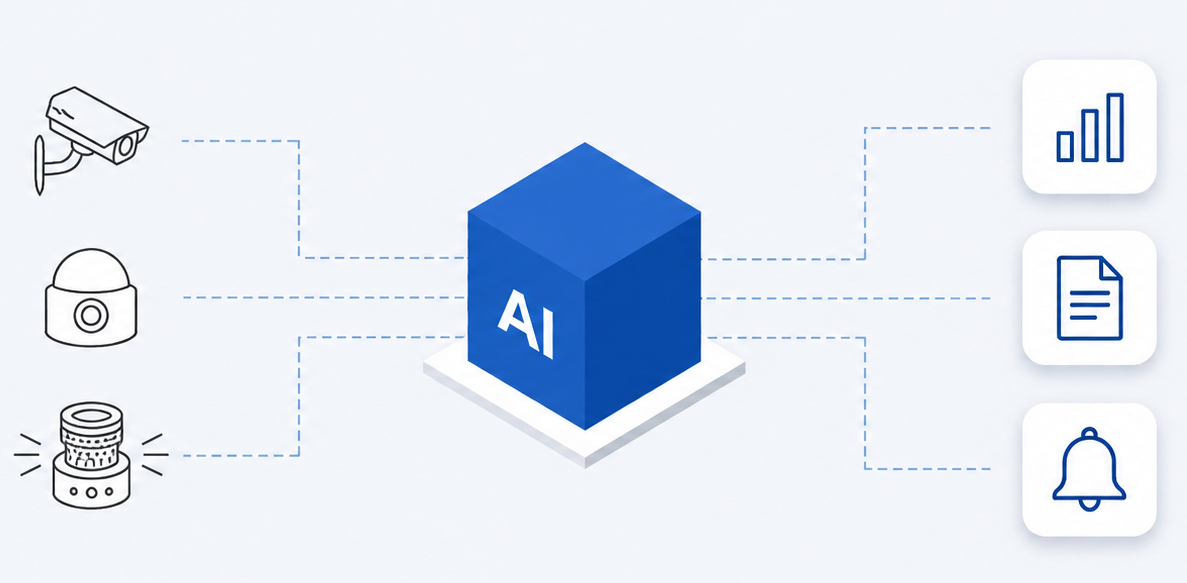
How the Technology Works
Supported Devices
The system works with a wide range of data sources — from standard cameras to thermal imagers and LiDARs.
Line-Scan Camera (1D)
Captures the image line by line as the object moves. Ideal for conveyors and product quality control.
Area-Scan IP Camera (2D)
Standard video surveillance for object and event analysis: people, vehicles, perimeter, and indoor spaces.
RGBD Camera (3D)
Adds scene depth to the image. Precise object geometry, volume measurement, and 3D analytics.
LiDAR
Laser scanning of the environment. Precise distances and object contours even in low light.
Thermal Imaging Camera
Operates in the infrared range. Sees objects in darkness, smoke, and fog; monitors overheating.
Scanning Devices
Specialized solutions for scanning and measuring objects: dimensions, defects, and marking.
Artificial Intelligence System
Object Detection
People, vehicles, and products in the frame — in real time.
Tracking
Following objects across cameras and over time.
Product Quality Control
Automatic inspection of products for defects and conformity to standards.
Segmentation
Object boundaries with pixel-level precision.
Event Classification
The system distinguishes normal situations from anomalies.
Attribute Recognition
Color, type, dimensions, and other object characteristics.
Core Platform Components
Modular architecture: each component operates independently and scales separately.
AI Models
Trained neural networks for detection, recognition, and segmentation.
Detectors
Object detection modules tailored to the customer's tasks.
Tracking
Object tracking and trajectory reconstruction.
Analytics
Event aggregation, process metrics, and dashboards.
API
Open interface for integration with external systems.
Data Storage
Archive of events, frames, and metadata with fast search.
Performance
Deployment Options
On-Premise
Installed on the customer's servers. Data never leaves the facility.
- Full control over data and storage
- Maximum confidentiality and security
- Works without an internet connection
- Deep customization to enterprise processes
Cloud
Processing in our cloud. Fast start without your own hardware.
- Launch in days, not months
- Elastic scaling to match the load
- Updates and maintenance on our side
- Convenient for distributed facilities
Integrations
Open protocols and interfaces — the platform integrates seamlessly into your existing IT infrastructure.
Reporting & Automation
Alerts & Notifications
- Alert system and emergency notifications to messengers
- SMS and e-mail notifications
- Information dashboards
Reporting
- Process performance reporting
- Automatic report generation
- Incident logging
Integration
- Integration with SCADA / industrial control systems
- Connection to corporate databases
- CRM integration
Automation & Control
- Control of external devices
- Control of robotic systems
- Automation of sorting and production processes